
by Johnnie Moore
Share
by Johnnie Moore
Share
A Bestshoring Case Study in Digital & AI Readiness
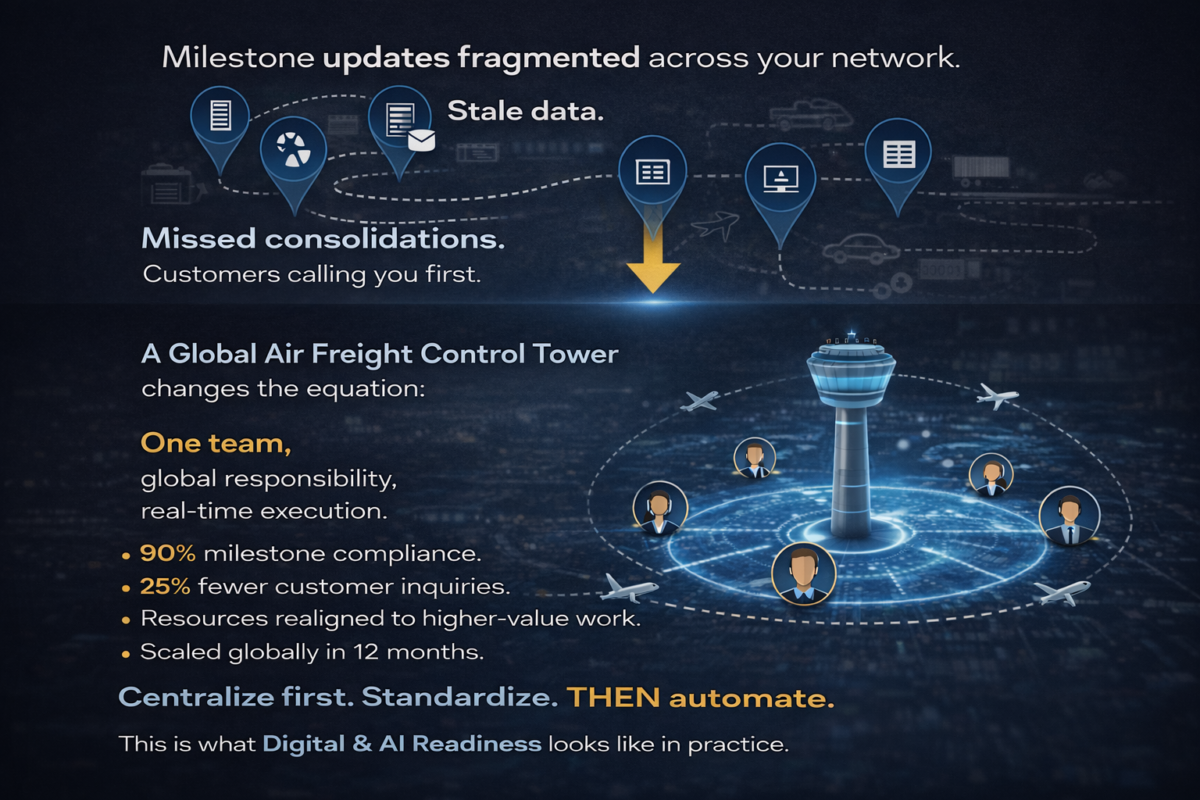
Milestone updates fragmented across your network. Some through EDI. Most manual. Every location doing it differently, on their own timeline.
The result: stale data, missed exceptions, reactive firefighting, and the question that signals your network is running blind: “Where is my freight?”
If your customers are asking that question, your milestone management is already broken.
When we deployed a Global Air Freight Control Tower for a leading freight forwarder, we achieved 90% milestone compliance and a 25% reduction in customer inquiries. Here is how.
The Problem with Distributed Updates
In a global freight forwarding network, milestone accuracy is the foundation for everything downstream: consolidation timing, rebooking decisions, customer communication, carrier accountability, and leadership visibility.
As Gartner puts it, a control tower only works when the organization has cross-functional integration already in place. Without it, the tower cannot observe enough signals to support accurate decision-making.
When updates are fragmented, consolidations get missed, exceptions surface late, customers call before you can call them, and leadership flies blind on volume flows and network patterns.
The Control Tower Model
A Global Air Freight Control Tower centralizes what was previously scattered. One team. Global responsibility. Real-time execution.
The mechanics: continuous review of all Masterbills against airline data, real-time updates to the TMS, and exceptions pushed immediately to teams responsible for resolution.
But here is the real transformation: this is not just about tracking. It is about creating the centralized structure that makes automation possible.
You cannot deploy RPA across multiple locations doing things multiple different ways. But the transition path itself is a design decision. Sometimes sequential makes sense: centralize, standardize, then automate. Sometimes parallel works better: migrate work into the new model while simultaneously developing and refining automation as work onboards.
The right approach depends on your readiness, scope, and capacity for change. That choice is part of Bestshoring.
The outcome: station resources realigned to focus further up the value chain, consistency improved, and a single source of truth for the entire network.
What Leadership Actually Gains
Beyond operational efficiency, a control tower becomes a nerve center for strategic intelligence: volume flow visibility, carrier performance scorecards built from actual data, market intelligence for leadership steering, and procurement leverage in carrier negotiations.
This aligns with industry direction. IATA’s Cargo iQ initiative has been driving toward exactly this: common business processes and milestone standards across air cargo. The question is whether your operation is structured to take advantage of it.
The Results
90% milestone compliance – up from inconsistent, unmeasured performance
25% reduction in customer inquiries – proactive updates replaced reactive firefighting
Scaled globally within 12 months – the model proved repeatable across regions
Station resources realigned – freed to focus on higher-value customer-facing work
Where This Fits in the Bestshoring Framework
This is what Digital & AI Readiness looks like in practice – the sixth dimension of the Six Dimensions of Bestshoring Readiness™ framework. Not the automation itself, but the structural consolidation that makes automation possible.
Understanding what Bestshoring really means starts with recognizing it is not about where work lives, but how it is organized to deliver value.
The question is not whether you need a control tower. It is whether your current model can survive without one.
Not sure where your operation stands? The Bestshoring Readiness Health Check™ identifies which dimensions need attention first – and helps determine the right transition approach for your situation. Five minutes. Twenty questions. Clarity on where to focus.
STAY IN THE LOOP
Subscribe to our free newsletter.
Leave A Comment

The model promised one thing and the operation is delivering another. Every fix so far treated a symptom. Take the picture of what is actually going on first.

The strongest distributed operations do not just deliver, they become partners their stakeholders trust to help steer. This case study shows how one operation built that partnership through structured governance, turning at-risk relationships into its strongest advocates: a 40 percent rise in actionable feedback and a 10-point gain in Net Promoter score.

Most organizations protect a slipping strategic account by starting with cost. The correct sequence runs the other way. A Bestshoring case study in Customer Program Management.

The 30th Annual SSOW Americas convenes in Orlando March 16-19. On Wednesday, March 18, Johnnie Moore serves as IDG Co-Facilitator on AI Governance, Panel Moderator for the GBS Scope Expansion discussion, and Track Chair for the afternoon program featuring CSL Behring and McCormick case studies. Here is what the agenda reveals about the design decisions GBS organizations need to make now.
